Why Using More AI Is Making You Invisible (And What to Do Instead)
Everyone has access to the same AI tools, the same prompts, and the same outputs. That's exactly the problem. Here's why the creators who win over the next five years won't be the ones who use AI the most — and how to use it in a way that actually makes you stand out.
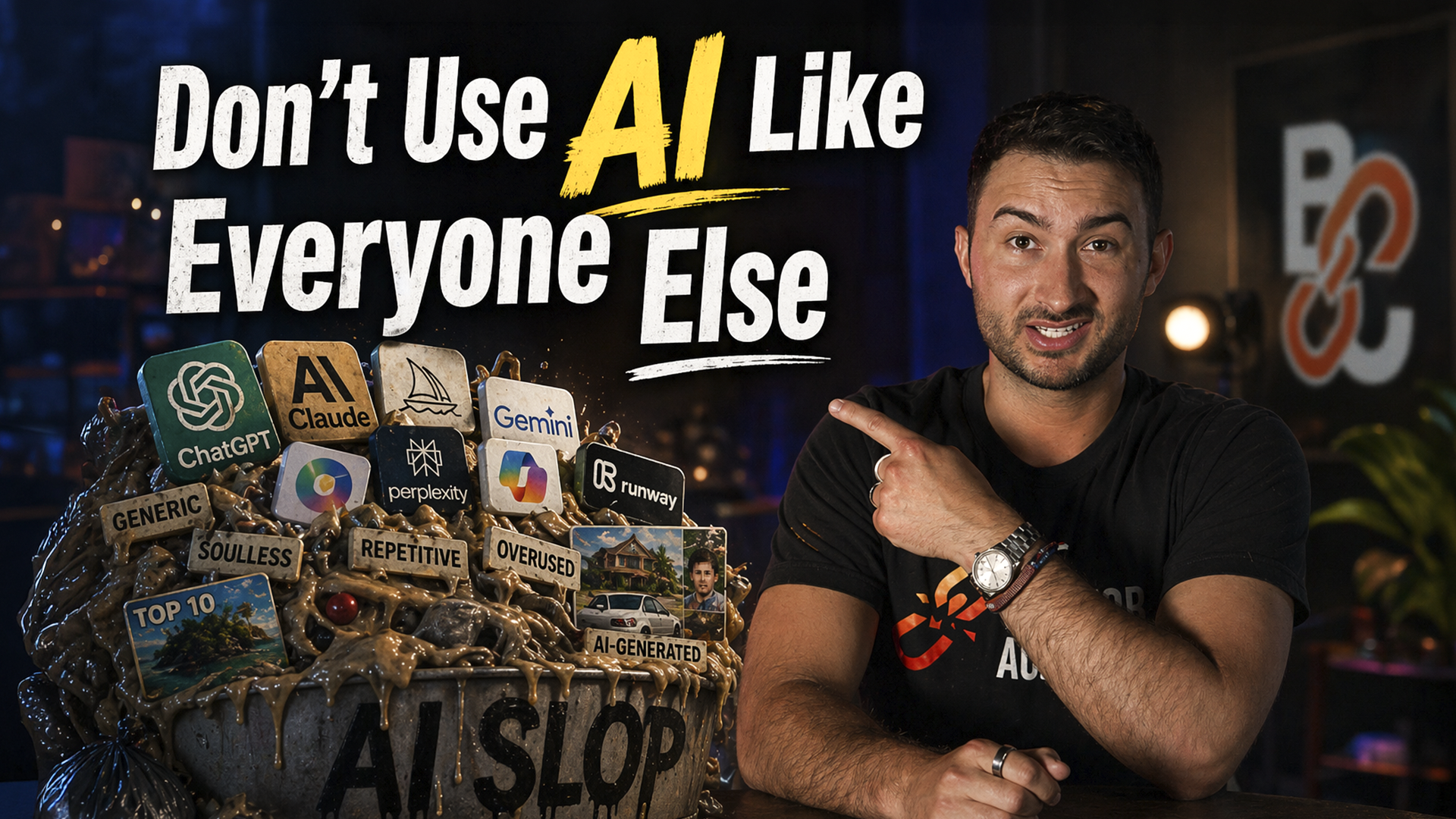
If you keep using AI the way most people are using it right now, you are going to make yourself completely invisible.
That's not a warning about AI being dangerous. It's a warning about what happens when a tool becomes so widely available that using it stops being an advantage — and starts being a liability.
The Problem With "More AI"
Here's what's happening right now. Someone opens ChatGPT and types: "Write me a viral script about success." What comes out sounds clean. It sounds structured. It even sounds impressive at first.
But it also sounds like everything else you've already heard.
Everyone now has access to the same tools, the same prompts, and the same outputs at scale. The more people rely on AI for everything, the more uniform everything starts to feel. The same tone. The same phrasing. The same recycled ideas packaged slightly differently.
And when everything sounds the same, nothing stands out.
The advantage you thought you had — speed, volume, efficiency — cancels itself out. Because now everyone has it.
Which means the real question isn't how do I use more AI? It's how do I avoid sounding like everyone else who's using it?
Why You Can Always Spot AI-Generated Content
You already know this intuitively. You've gotten a message that says something like:
Hope this message finds you well. I wanted to reach out and express my interest in connecting further.
Nothing about it is technically wrong. But something feels off. The tone is slightly too polished. The structure is a little too perfect. The phrasing feels generic. There's no personality, no specificity, no real perspective behind it.
You can't always explain it — but you can feel it.
Real communication has texture. It has imperfections. It has opinions and conviction. AI-generated communication smooths all of that out. So even when the words are good, they don't feel right. And when something doesn't feel real, people subconsciously trust it less.
Here's the honest truth: we can all tell when your content was written entirely by AI. And that perception instantly lowers how much people value it.
The Economics of Rarity
Think about this. A 1952 Topps Mickey Mantle baseball card sold for $12.6 million. A 1985 Super Mario Bros. cartridge sold for over a million dollars. Why?
Because there are almost none of them left.
Value comes from rarity. It's the same principle as inflation — the more dollars you print, the less each one is worth. Apply that same logic to content.
If AI makes it easier to create content, more people create content. When more people create it, it stops being rare. And when it stops being rare, people stop valuing it the same way.
The issue isn't just that there's more content now. It's that most of it feels interchangeable. And interchangeable content doesn't build audiences, trust, or income.
Where AI Is Actually Getting Its Ideas From
Here's what most people don't think about: AI doesn't think. It pulls patterns across existing content on the internet and recombines what already exists.
Which means if you rely too heavily on it, you're not actually creating anything new. You're remixing what has already been said. That's why so much AI content feels familiar — it's not bad, it's just not original. And over time, that becomes a serious problem. If everything you produce feels slightly recycled, people stop remembering it. And people don't care about it.
What's Actually Becoming Rare
Think about the last time you received something that felt genuinely personal. A real voice memo. A thoughtful message where you could tell the person actually stopped and thought before they responded.
That's what's becoming rare.
Most people are optimizing for speed — faster replies, faster content, faster output. But faster usually means shallower. So now anything that feels intentional immediately stands out. Not because it's flashy. Because it's actually real.
A thoughtful email. A real voice note. A creator who takes time to think before they post. These things are becoming increasingly rare — and therefore increasingly valuable.
The people who will be most successful over the next three to five years won't be the ones who use AI the most. They'll be the ones who use it the smartest.
The Actual Mistake Most Creators Are Making
Here's what it usually looks like. Someone opens AI and says: "Give me 10 content ideas. Write me a script. Make this go viral." And they build everything from that.
The problem is they're starting with AI instead of starting with themselves. They're outsourcing the hardest part — thinking. Thinking through ideas. Structuring thoughts. Forming actual opinions.
That's the part that creates originality. And when you skip it, everything you produce feels generic. Because it is.
The Right Way to Use AI
The shift is simple but it changes everything:
Come up with the idea first. Outline it yourself. Decide what you actually believe. Then bring AI in to refine, tighten, and improve.
Now it's your actual voice — just sharpened.
Want to see how to build this kind of content system in practice? Watch How to Build a Christian Content Strategy That Actually Grows on YouTube →
If you are also wrestling with whether using AI is spiritually appropriate, read Is Using AI a Sin? A Christian Guide to AI, Faith, and Discernment.
- —Start with your own thinking, not a blank AI prompt
- —Form a real opinion before you ask AI to help you express it
- —Use AI to improve your ideas, not generate them
- —Let your specificity and lived experience be the thing AI can't replicate
When you let AI generate everything from scratch, you skip the one step that makes your work valuable: you.
Convenience vs. Differentiation
When you zoom out, all of this comes down to one decision you make every time you open an AI tool.
You can choose convenience — let it generate everything, move fast, produce volume.
Or you can choose differentiation — bring your own perspective first, use AI to sharpen it, and create something that actually sounds like you.
One path makes you faster. The other makes you valuable.
Long-term, only one of those actually wins.
The Bottom Line
AI is not the problem. How most people are using it is.
The creators who build real audiences, real trust, and real income over the next five years will be the ones who understand that the tool is only as valuable as the thinking behind it. Your voice, your perspective, your lived experience — those are the things AI cannot replicate at scale.
Use it to sharpen your ideas. Never use it to replace them.
What's your favorite thing you're using AI for right now? Drop it in the comments — let's help each other get better in the AI age.
Online Campus Pastor at V1 Church. Husband, father, media strategist, filmmaker, and creator economy builder. Read more about Evan →
Ready to build your platform?
Join 1,000+ creators who have gone through the Breakers Creator Academy — built for Christians who want to build a platform and monetize their message.
Join the Academy — $37/mo